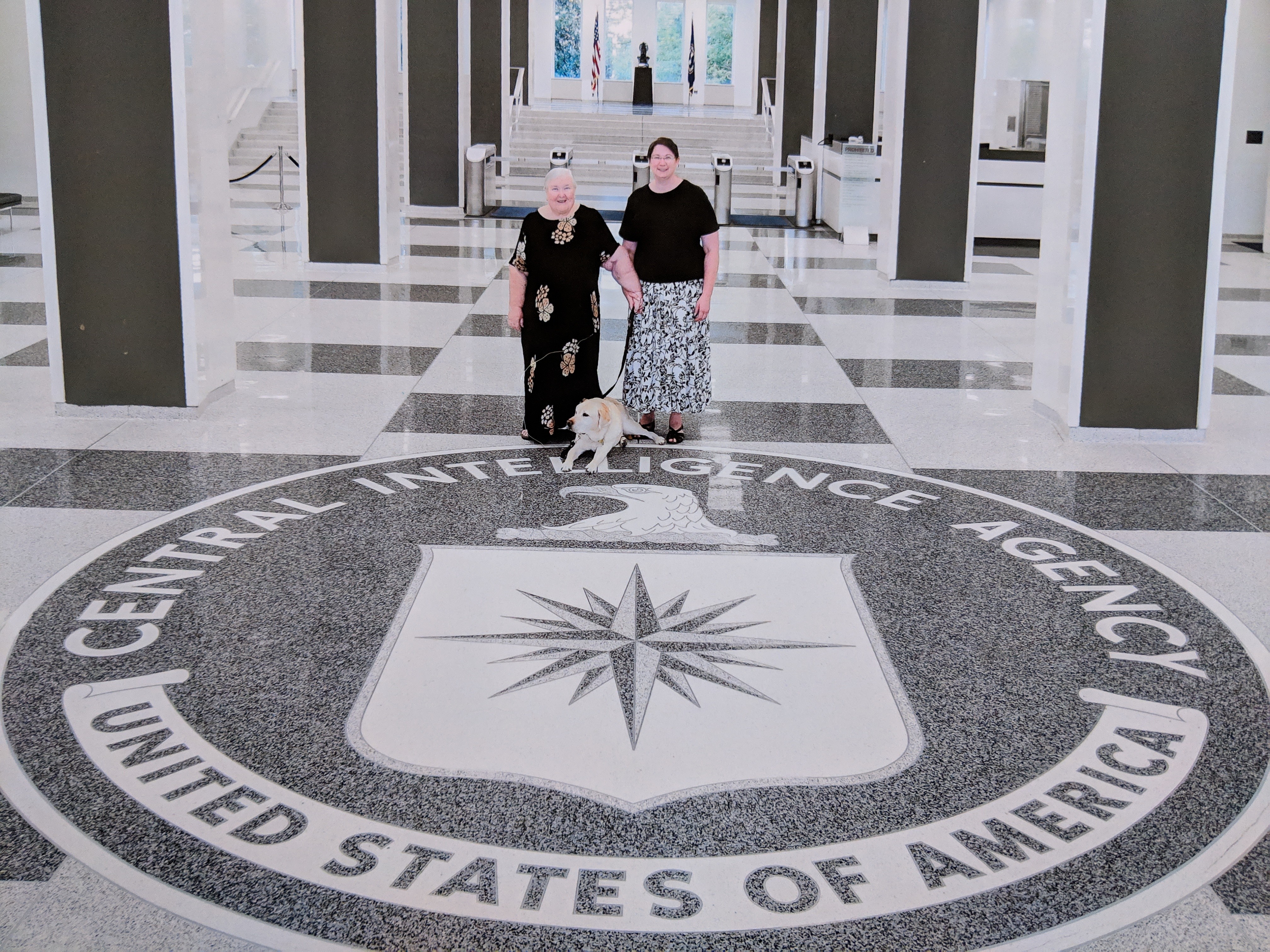
What a joy to be on the platform to encourage those wherever I may wander…
This past month I had speaking in Tennessee, Ohio, and Washington, DC. It was DC that held one of the highlights of my speaking, I was invited to give a keynote address at the CIA!
It is hard to believe that some thirty eight years ago I worked for the FBI and now returned to Washington to speak for the CIA!
The highlight was during the Q and A time when the Deputy Director of the CIA asked me, “If we would send you an application, will you apply?” People still respond well to my FBI stories.
My eyes were mesmerized by the enormous size of the CIA building but what a shocker to see engraved on the large granite walls in the main entrance the words from the Bible, “THE TRUTH SHALL MAKE YOU FREE”. The Word of God is Rock solid, timeless in it’s truth, and still speaks when and where we least expect it.
When the TV series, Sue Thomas FBEYE was released, the TV Guide did a feature article on me with a photo session of me and my dog, Gracie, standing on the FBI seal. Today, I stand on CIA seal as a remembrance of my time on their platform.
The miles continue…what an incredible journey it is in my wanderings!
Leslie Basham: Sue Thomas has worked for the FBI, and she’s been the inspiration for a TV program, but one of her most meaningful activities is finding homeless people on cold streets. She’s planning on doing it this holiday season.
Sue Thomas: I know where I want to be every Christmas. I want to be on the streets with the homeless. Each year now for the last thirteen years we’ve traveled to Washington, D.C. I remember them very well from my FBI days how many homeless live on the street.
Leslie: This is Revive Our Hearts with Nancy DeMoss Wolgemuth, author of The Wonder of His Name, for November 30, 2017.
If you’ve missed any of the programs this week. I hope you’ll visit ReviveOurHearts.com and catch up. Nancy’s been talking with Sue Thomas who lost her hearing at eighteen months. Because of the investment of her parents and some teachers and coaches, she became a musician and ice skater. She also worked for the FBI, reading lips during surveillance operations and inspired a TV series.
article written by Elaine Tomski and reprinted with permission by JPV Press
He dozed in a rock-hard feeding trough lined with hay stubble. The night was cool, the stable dark. The pungent odor of manure fragranced the intake of His first breath. The bleat of a lamb, the swish of a cow’s tail and the sweet whisper of a mother touched His ears. His was a lowly birth, that first silent night. It was the night He traded the glory of heaven for the filth of this sinful world. The place is Bethlehem. His name is Jesus. It is the first Christmas.
Move now to 2003. Sue’s father has been gone for seven years and she celebrates Christ’s birth with her widowed 90-year-old mother. The mother who has lovingly made every Christmas season a joyous celebration for family, friends, and neighbors. Sue says, “Mom always began baking cookies the day after Thanksgiving.” She baked dozens and dozens of cookies for the guests who would come through the Thomas’s front door. Once inside, the laughter and music would be just as sweet as her mom’s trays of cookies. Sue says, “Christmas hymns were part of the daily atmosphere of my home and the carols of Christ’s birth were the grand finale at the year’s end.” That Christmas, after friends and neighbors were gone and only the cookie crumbs remained, Sue gently held her dear mother close and shared from her heart, that there could be no Christmas without her. Two short months later, in February of 2004, heaven called Clara Thomas home. Each Christmas to come will have to be celebrated without her. But, how?
Thanksgiving 2004 approached and the question of what to do with Christmas remained unanswered. As the wind blew bitter cold through the streets of Cleveland, Ohio, Sue Thomas walked swiftly with her friend Deb from the theater back to their hotel. On the sidewalk, they discovered a homeless couple cuddled over a steam grate under piles of blankets and newspapers. Sue stopped to give them some bills from her wallet and began to walk away. After a few steps, she stopped again. “Deb, we can’t leave them. We have to get them a room for the night.” So, that night, the couple had a hotel room with a hot shower and a clean, soft bed. The following morning, they enjoyed breakfast with hot coffee. Upon discovering this homeless couple, Sue had found the answer to her question. She realized where she wanted to be on Christmas. “I knew I wanted to be on the streets with the homeless.” This revelation was just the beginning of what would soon become Operation Silent Night.
REAL SILENCE
Every night is a silent night for Sue Thomas. Born and raised in Youngstown, Ohio, she became profoundly deaf at just 18 months old. Her dedicated parents made certain Sue would have the tools she needed to survive in a world of sound. Years of speech therapy taught Sue to speak even though she heard nothing. The pathway wasn’t easy, but with the help of a high school teacher who recognized Sue’s potential, she made her way to college and a meaningful career. Sue is well known for her professional work with the Federal Bureau of Investigation in Washington, D.C., where her skillful lip-reading abilities have been used to solve criminal cases. A more recent medical challenge of Multiple Sclerosis (MS) does not discourage Sue’s efforts. She speaks, writes, and keeps right on serving, traveling with the assistance of her service dog, a yellow lab named Sir “Rodney” the Great, and her full-time associate and friend, Deborah Shofstahl.
TRY, TRY AGAIN
The first year of Operation Silent Night (2004), Deb, Sue, and her then service dog, Katie, took hot chocolate and 50 hot sandwiches in a cooler. Deb says, “We gathered up coats and blankets out of the attic and went to the streets of Cleveland on Christmas Eve. When I look back I can see it was God’s protection, having the dog with us.” Some of the homeless were afraid of her. At first, Sue and Deb were having trouble finding people, so at one point, Sue rolled down her window and called out, “Anyone want any hot sandwiches?” Around twenty homeless people came out of nowhere. Sue says, “It was a memorable evening.”
In 2005, the Maynard and Marietta Troyer family began serving with Sue and Deb. For a few years they all served in Cleveland on Christmas Eve. After federal grants began supplying funds for homeless shelters, they found almost no one on the Cleveland streets. Soon they were seeking out the homeless in Pittsburgh, Pennsylvania, but also discovered very few.
Having worked for the FBI, Sue had traveled to our nation’s capital multiple times. It finally occurred to her; “I know where we can find homeless people. They’re all over Washington, D.C., sleeping on the monuments and on the stairs leading to the Capitol building. We’ll go to Washington, D.C.!” So, the next year, that’s what they did. Deb says, “The unique thing about being there at Christmas is that the whole city shuts down. We sort of have the city to ourselves with the homeless.” Thankfully, their fully stocked food truck and bus stuffed with gifts and volunteers have none of the usual traffic worries.
Life is hard for people who have no place to call home. They live with hunger, rejection, and pain. They come from broken homes, they battle addictions and are alienated from their families. Although some are experiencing the consequences of their actions, many are dealing with mental illness. Finding a place to sleep at night begins with standing in line outside the shelter for hours. After the doors are opened and the shelter capacity filled, the rest of the people are turned away to fend for themselves all night. Even when fortunate enough to spend the night in a shelter, everyone is turned out onto the street the next morning to make their way, stay warm, and find food until they must stand in line again. Deb says, “Fixing the problem is not as simple as these people just getting jobs. They are dealing with so many problems, the fix is never easy. We always reach out with the love of Jesus and a smile without judging them.” Sue adds, “They aren’t the forgotten people. We remember them. They’re real people with real stories.”
PERSON TO PERSON
…Inasmuch as ye have done it unto one of the least of these my brethren, ye have done it unto me. Matthew 25:40
According to Deb, “You learn pretty quickly, the number one thing is relationship, so it’s not about giving things away. It’s really about taking the time to make that person feel important.” Sue remembers the first Christmas they gave away comforters. She walked up to a man lying on the ground and said, “Sir, I have a gift made especially for you. It’s our hope that it will keep you warm.” When he looked up at her she asked, “Sir, may I tuck you in for the night?” He smiled. She placed the comforter over him, tucked it under his feet and thought to herself This is the best Christmas I’ve ever experienced…my entire life! She shared the love of Christ as she tucked in a stranger that night.
Maynard recalls a cold, rainy Christmas Eve they found someone lying over a grate for warmth. There were two feet sticking out from under blankets and an umbrella. It was heart-wrenching to discover this cold, drenched, homeless person to be a girl about the same age as his own girls. He says, “That touched me deeply. Then, it was like God supplied specifically for her because we had one pair of coveralls and one pair of boots that fit her exactly.” He recognizes God’s provision every year saying, “We don’t preach at people, but God always opens doors so we can pray with people. It’s such a blessing to just go love on them. Feed them. Be their friend for the day.”
Deb remembers a year they found it difficult to leave the warm bus. It was only 12 degrees and windy. “There was a pile of blankets next to a lamppost, so we stopped.” They found a young woman in her 30’s who hadn’t made it into a shelter, so she made her bed right there. “What struck me was, right above her head tucked into a brick, there was a Christmas card. She had built a little bedroom, under the light, with a Christmas card over her head, in 12-degree weather.” The strangest thing is that this sweet homeless gal kept questioning the volunteers, “What are you doing out on a night like this?” Deb says, “That year, ladies had made neck pillows to give away.” How grateful this homeless lady was to receive a pillow for her head.
Marietta enjoys connecting with her small Asian friend Lulu each Christmas. “She’s always a highlight!” Two years ago, Lulu shared that she was battling cancer. While living on the streets, she was also receiving chemo treatments. Concerned about her chance for survival, Lulu confided, “I don’t think I’ll be seeing you next year.” Marietta says, “But sure enough, last year, there she was! She looked so good!” Maynard adds, “We have our regulars that we know down there.”
Another favorite regular is Big Ron. “I look like a dwarf next to him,” Maynard says, as he recalls a Christmas Eve they were having trouble finding people. Typically, the bus stays away from a park known to be filled with unpredictable drug users, but this year they pulled close in order to find the homeless. Maynard says, “We left the bus and just got mobbed there. I was trapped against the side of the bus unable to move. Marietta was in the bus doorway passing out gifts to the street folks and they were grabbing for stuff. All of a sudden this big black guy walked up and hollered, ‘If you want something you get in single file and no grabbing! If you get caught grabbing, you will have to get out of line and you will not get anything!’” Big Ron is their unofficial security guard. It seems he’s pretty good at crowd control. He’s good at giving hugs, too. Big Ron always comes onto the bus to give Sue a big old smelly hug and calls her “Mom.” Sue loves those hugs and reports they have around eight regulars whom they see every year.
One Christmas morning, there were socks and gloves left over from Christmas Eve, so back out to the streets they went. Deb approached a man to give him a pair of socks. She discovered he was a Vietnam veteran who had been released from the VA Hospital just two days earlier following foot surgery. He was quite happy with the sock booties the hospital had supplied, and she says, “I had to convince him he could have more than one pair of socks. He was as sweet and pleasant as could be.” How sad to be released from the hospital with no place to go.
REAL CHALLENGES
The first challenge volunteers encounter on Christmas Eve is in finding the homeless. It can be a bit like hide-and-seek. They find them in dark alleys and dumpsters. They seek out piles of newspapers and cardboard boxes. The people are hiding for warmth and safety. Because they are often rejected, homeless people are very cautious. They might even refuse the offered gifts because they find it difficult to trust. Maynard says it helps if you learn to talk their lingo. Sometimes, a homeless person will receive a gift from one of the Troyer children when they don’t trust the adults. If they refuse to accept a gift from the volunteers or even the children, Marietta says, “They always accept it from Sue.”
You may be wondering what kind of gifts Operation Silent Night brings. For the past three years they have given out backpacks filled with survival items for winter, such as toilet paper, toothbrush, toothpaste, heavy socks, gloves, hats, scarves or ponchos. The backpack is easy to carry and can serve as a pillow for their heads. Sue says about the gifting, “Each year we’ve been able to add a new item we wouldn’t even have imagined.” Last year some ladies crocheted plastic shopping bags into mats. They are waterproof and perfectly provide cushion and insulation from the cold, hard ground.
Marietta takes care of organizing the bus a local church lends them for the holiday. The back half is loaded from floor to ceiling with backpacks for men and women, coats, shoes and boots, extra socks, Bibles, tarps, flashlights, crocheted plastic mats, Amish-made comforters and miscellaneous items. The food truck, owned by Operation Silent Night, carries 225 hot sandwiches, hot chocolate, cookies, and goody bags filled with cans of Pepsi, bottles of water, trail mix, applesauce, potato chips, beef jerky and all kinds of snacks. The challenge comes when volunteers are faced with how to be both efficient and helpful. As they give a sandwich, hot chocolate, cookies, goody bags, blankets and backpacks, the homeless people run out of hands! Isn’t that a wonderful problem? Serving 175-200 people every year, Deb says, “We don’t want to treat people in assembly-line fashion. We want to treat each person as an individual.” New for this Christmas will be duffle bags, even larger than backpacks, to hold more gifts for giving.
A challenge for both Operation Silent Night and the homeless person is obtaining shoes and boots. Too often, homeless people receive cheap shoes or flip-flops, but what they need are warm winter boots and good quality shoes able to survive harsh weather and constant wear. Volunteers never have enough to give away. They need men’s boots of all sizes and women’s boots in large sizes. Even rubber boots to keep feet dry are welcomed.
KIND DONORS
Every year, Sue gathers all kinds of free items. She doesn’t let the physical limits of MS keep her from making yearly visits to Giant Eagle, Arby’s Chick-fila, Wendy’s, McDonald’s, Subway, Dunkin Donuts, and Sam’s Club. Marietta says she’s even heard a Sam’s Club manager tell the employee assisting Sue, “Just give her whatever she wants.” Walnut Creek Cheese donates the ham and cheese for hot sandwiches. Arby’s donates hot sandwiches, too. And what would Christmas Eve be without cookies? Just like Clara Thomas, Der Dutchman provides dozens and dozens of cookies for the event.
Vendors from Ruby’s Country Store in Winesburg, Ohio, have been known to donate boxes full of hats and gloves. Kind Amish ladies from Meadville, PA, make beautiful single bed comforters in dark and bright colors, perfect for not showing the dingy wear of street-life. They also make pillows for weary heads. Having a comforter and pillow brings a feeling of home to folks without a home. Maynard and Marietta’s children purchase a special gift each year. They watch and pray while making their way through the streets. Every year God shows them the exact person who needs the gift they have to give.
Sue says, “I know a man from years ago. He had a mental disorder and got his life back together after four years of being homeless. Now, each Christmas he sends a donation of $35 for one item only…Jolly Ranchers hard candy. He has taught us from his own experience, the best way to approach and make friends is with a piece of hard candy.” Sue is grateful for his first-hand knowledge and generosity.
Now that it has become more difficult for Sue to walk, she takes the opportunity to sit in the front seat of the bus to encourage the people and hand them one last gift. She tells them, “I want you to have another meal this week or next week. Here’s a gift card so you can get food or hot coffee.” She loves giving out fast food gift cards and receiving genuine hugs. Marietta says, “They really connect with her.” Sue says, “Once you see that look of gratitude from someone who has nothing, you never forget it.” Maynard says it this way, “We’re always more blessed than the people we serve. Some of what you see is etched into your heart.”
That’s how it will be again this Christmas when Sue, Deb, and their volunteer family will be on the streets of our nation’s capital, blessing homeless people with the love of Jesus. Now, 13 years after Sue believed she could never celebrate Christmas again, Operation Silent Night moves into Washington, D.C. every Christmas Eve because of what she learned from the servant heart of her mother. The greatest gift is truly found in giving.
“Operation Silent Night just keeps getting bigger and better,” says Sue. Always a visionary, she’s dreaming of a warehouse. Marietta agrees and would also welcome a bigger bus. They collect donations right up until the morning of December 23. Currently, their greatest needs are:
Funds for purchasing meal cards
Boots and shoes
Comforters
On that first silent night, He came to make peace between God and man. He came to take our sin and give us His holiness. He came to make us right with God again. He did it for you and me. He did it for the homeless people sleeping on rock hard concrete in cold, dark places, where filth breeds. He offers us all a dignity we will never deserve. His name is Jesus. The place is your heart.
Leslie Basham: Sue Thomas is an expert at reading lips. It got her a job at the FBI, which inspired a TV program. But none of those things give her identity.
Sue Thomas: But I don’t want the world to know me as “Sue Thomas: F.B. Eye.” I want the world to know me as “God’s greatest sinner saved by His grace—and grace alone!”
Leslie: This is Revive Our Hearts with Nancy DeMoss Wolgemuth, author of The Wonder of His Name, for November 29, 2017.
Nancy DeMoss Wolgemuth: The conversation we’ve been listening to over the past few days represents a first for me. I’d never before conducted an interview with someone who couldn’t hear my questions . . . until I met Sue Thomas, an expert lip reader.
I have to say that this interview is one of the sweetest that I can remember having in a very long time. Now, let’s review just a little bit of what we’ve heard from Sue the last couple of days.
Nancy: When you got out of college, you wanted to find a job, but it wasn’t very easy.
Sue: No, there wasn’t one person that was willing to hire me. I couldn’t answer the phone. They were afraid that because I was deaf, I wouldn’t understand, that I would make mistakes.
I ended up going back to the same speech clinic that taught me to speak. I pounded on their door, asking for a job. I know they felt sorry for me. Why? They hired me, even without a job to offer. I was like a gopher, a jack-of-all- trades.
I can remember some days taking paper clips out of one box and sticking them in another closet. That was my job. But God was still writing the chapter of my life, because there was a friend that was at that speech clinic who in turn had a friend that worked for the Federal Government, who in turn had a friend that worked for the Department of State, who in turn had a friend that worked for the FBI.
Nancy: How does the Lord write those stories? That’s amazing!
Sue: It is.
Nancy: And you got the message that there might be a job for you at the FBI.
Sue: What I didn’t realize was that they were looking for deaf people to start a new program researching classified fingerprints. All those funny lines on the fingertips are fingerprints, and no two people have the same.
They thought if deaf people would come and search the fingerprints, it would be a lot faster and a lot more detailed than having a hearing person do it, which was currently the way it happened.
You start looking at this print, and you have to count each one of those lines. Well, for a hearing person in the middle of the count, if somebody sneezed, they would look up to see who sneezed—and they would have to start at the beginning of the count again.
Or if somebody dropped a book, they would find out what book was dropped, and they would have to start again—over and over. But there was some bright idea at the FBI that if they hired the deaf people, then people could sneeze, doors could slam, books could drop.
They were deaf; they would never see it, so they would just keep counting. And that’s the way it was. But that wasn’t what God made me for, to count lines. I’m a people person; I love people. There’s a whole other session about that.
But while I was there counting the lines, one day my supervisor came to me and said that they wanted to see me in the front office. And there were only two reasons a person went to the front office—either to be terminated from their job or to be interrogated by the FBI agent.
So I went to the front office that day. When I walked in, there were nine men waiting for me, and they told me to sit down. They started asking me questions. And in the end, I came to realize that they had a big problem!
They were working on a case in which they videofilmed the suspect. But in this particular case, when the camera activated, the sound mechanism failed. They had all this film with the bad guy talking, but they couldn’t hear him.
They wanted to know if I would watch it and write down any words. I said, “Sure, no problem!” From that day on I never went back to reading fingerprints. I read lips for the FBI. And to sum up my job, I followed the bad guys around; I read their lips, and I told the good guys what the bad guys were saying . . . and they even paid me to do it, too!
So I had a whole unique job. I became known as “the secret weapon for the FBI.”
Nancy: When we left off yesterday, Sue Thomas was thirty-five years old, and she had just come to faith in Jesus Christ—an experience that gave her, for the first time, freedom from her shame and sin.
She realized she was completely forgiven, but she still needed to clear her conscience with those that she had wronged. That meant going before a Board at a Bible college, where she had lied on some paperwork.
And that Board included a man who had especially invested in her life.
Sue: So I was out of tears and feeling the shame. I know, when I cry my speech is very garbled. I know that they have a hard time hearing. But my eyes were transfixed on one man, and as I was sharing, he was sitting in the chair. Then I saw him bend over, and he put his head in his hands and I saw tears falling. He was shaking his head back and forth like, “No!” He was in disbelief. That day, I realized that there was one man that wept for my sins, and that man was Dr. Robertson McQuilken, President of the Bible college and seminary.
It would be twenty years after I left, that I knew that he was speaking somewhere. I had to go and see him, to thank him. When I got there, unknown to me, they put me at the dinner table right next to him.
As I arrived and I sat down, he looked at me, and he reached over and he patted my hand. He said, “Oh, Sue. I am so proud of you!” And with that, I started to choke. I mean, the tears started to well up, and I knew I had to get out of there!
I looked at him, and I said, “Dr. McQuilken, you have to excuse me for a minute; I’ll be right back.” As I’m walking out of the cafeteria, the tears are streaming down my eyes. I’m saying to God, “He doesn’t remember. He can’t possibly remember.”
I came back, and I was composed. I looked at him and I said, “Dr. McQuilken, I came specifically so I could meet with you, privately, for just a moment—sooner rather than later. Is there any time?” He said, “Tomorrow morning.”
I said, “Okay.”
I met with him, and I met with the current President, at the time, of Columbia Bible College—those two men together, and my assistant Deb was with me. I looked across and I said, “Dr. McQuilken, do you remember—in your tenure—was there ever a time when you kicked someone out of the school?”
And he looked at me and he paused. He was thinking. He finally said, “Well, I don’t think so, but I really don’t remember.” Then he leaned forward and he looked me straight in the eye, and he said, “Did we kick you out?”
I said, “No sir, you didn’t—but you could have. Maybe some would have thought that you should have, but you didn’t. And because you didn’t, you taught me the biblical principle of the love, of the forgiving, of the healing, of the restoring, and then the sending. Basically, because of you, I have eternity, and I have had my desire to make Him known.”
That was the one thing that, when I came to the cross, was my whole heart’s desire—that He would send me to every nation, to every generation, to proclaim His love and forgiveness.
“And by your forgiving me, you have allowed that to happen.” Well, we went on to become very close friends. He was my spiritual father, and last spring when I went to Columbia to speak to the chapel, I knew it would be the last time that I would see him.
But the main thing . . . I know the Man that saved my life, and I knew the man that wept for me. The Man that died, and the man that wept . . . and it’s made all the difference!
Nancy: Jesus, who died for you and the President of that Bible college who wept for you. I’m thinking about some mom, some dad, some teacher listening today who is grieving over the lostness of the sinfulness of someone they love and saying, “Those tears will not be in vain.” God is going to water those tears with His grace.
It was through those man’s tears—Dr. McQuilken, who is now with Jesus—it was through those tears that God brought you to experience His love and His grace and His forgiveness in a way you had never experienced before.
Now, as you went to seminary, you were looking for God—to make Him confess that He made a mistake! As you left seminary, what was your view about your deafness? Did you still believe God had made a mistake?
Sue: No. You see, from the moment that I surrendered to Him and I said that He had to live in me, there was a healing that began to take place in the acceptance of my deafness. Acceptance is one thing, embracing it and living it is something else.
He had taught me that it was truly in the silence that we hear the still small voice of God—whether you’re hearing or whether you’re deaf. To come into His presence, you can only come with the silence.
So the more I grew in the understanding, the more I sought the silence. I just didn’t embrace it. I grew to love it, knowing that He would speak! The transformation of that cross—when you experience the before and the after—it’s so powerful! It’s even hard to testify what lies in that transformation.
And for me, each day, when I wake up in the silence, I praise Him for the eyes to be able to behold His attributes and His beauties. He has taken something, but He has replaced it with something far greater—the silence.
I would wish for every brother and sister that they would have the silence in their day—the stillness, the total silence. That’s a little hard, because I realize you will hear the birds sing, you will hear the surroundings, as far as that.
Me, I close my eyes, and I’m in the presence of God! And wow! It’s really a “wow factor” that I wish everybody could experience! I think you just have to stop and wait for that moment.
Nancy: Maybe that’s what David was thinking when he wrote in Psalm 62:1–2, “For God alone my soul waits in silence; from him comes my salvation. He alone is my rock and my salvation, my fortress; I shall not be greatly shaken.”
And so, David had many things going on around him, much noise, much war, many things with his kingdom, many people to listen to, many people wanting him to talk to them, but he would go to that quiet place and would say, “My soul waits in silence for God.”
Sue: Is that where we find Him, in the cave all the time?
Nancy: Yes.
Sue: Yes.
Nancy: That’s where Elijah found Him too, isn’t it? In the silence, in the cave.
Well, as I’m listening to you talk, I’m thinking about a book that my husband and I plan to write together called, You Can Trust God to Write Your Story. I’m listening to your story, and I’m thinking how God has written a script for your life that is different than you would have ever chosen . . . but it is beautiful!
You couldn’t even imagine, when you were thirty-five years old, all the things that God had in store for you, all the ways He planned to use you to proclaim the gospel around the world.
One of the ways that God began to open those doors and those opportunities was through a TV show. Many of our listeners know about you because they’ve seen this television series that’s based on your life and your years at the FBI.
So, tell us how that show—it’s called Sue Thomas: F.B. Eye—how did that show come about?
Sue: Shortly after I wrote the book Silent Night, a man picked it up and read it. He approached me about making it into a movie about my life. That man was the Vice-president of Columbia motion pictures. We went on a journey there, where I saw Hollywood in a way that very, very few people do.
I was wined and dined ,and the executive president said they wanted this movie. But we were at a crossroads during this time, where SONY International was buying out Coca-Cola for the ownership, and the movie kind of fell between the cracks during this transition.
But the writers that wrote the script of the movie kept it, and for all these years it lay dormant in their hands until they pitched it to make it into a weekly TV series. So there were years that went by before it actually happened, and then the TV series came out.
I will confess to you, as well as to your listeners, that in many ways I have looked at that TV series as a thorn. Why is that? Because the world knows me as “Sue Thomas: F.B. Eye.” But I don’t want the world to know me as “Sue Thomas: F.B. Eye.” I want the world to know me as “God’s greatest sinner saved by His grace—and grace alone!”
When I’m invited to the church, the church wants to hear the FBI. But I’ve come to realize that in this world I’m in exile, for heaven is my home, and this world is my exile. But God has taught me and has showed me that this is the way that He has chosen for me to have the doors open to proclaim the truth, the whole truth, and nothing but the truth.
It was shown for three-and-a-half years here in the United States with a viewership of three- to four-million people. But remember I said, when I came to the foot of the cross, it was my desire that He would send me to every nation, to every generation. I didn’t know how He would do it.
But once again, He would use the FBI and the TV show! Sixty-four nations around the world watch Sue Thomas: F.B. Eye.
Nancy: You told me that when you went to India to speak.
Sue: Right.
Nancy: People would come—crowds would come—to hear you because they had seen Sue Thomas: F.B. Eye over in India.
Sue: I mean, we get emails from all around the world: Malaysia, Singapore, South Africa—I mean, sixty-four nations! It’s all about the TV show, but there’s a way that I can correct them, by sharing the truth of the story of Sue Thomas and the Sovereign grace of God.
So God has used this. We went to India for three weeks, speaking to the multitude of thousands. We’ve been to Japan, to Germany. He has used it. He has brought me low with frailness, with illness, and I’ve been basically off the road, and my voice has not been heard for almost seven years.
But He has restored me. He’s bringing me back, so I’m looking forward to the rest of the journey!
Nancy: You just referred to illness in your life. You have multiple sclerosis.
Sue: Right.
Nancy: How did you come to find out about that diagnosis?
Sue: It would be sixteen years this February. I was on my way to Dallas, Texas, to do a huge women’s conference. It was the week before, and my little index finger went numb . . . and it kept spreading as the week went by. It went up to my shoulder.
I saw the doctor, and we did CAT scans and x-rays. Basically, he did not want me to go to Texas. I told him I was their only keynote speaker; I had to go. So he said, “Okay, go, but as soon as you get there, call me, and let me know you made it okay.” And I went.
I did the opening session. I wasn’t even halfway through when I was getting violently ill. I knew I had to get off the platform. Now, I’m in a group of like ten-thousand women, and I looked at them and I said, “You know, we’ve been talking about some heavy things here. We need to take a break, and I want you to sit in the silence and listen to the still small voice of God. I’m going to give you a few moments, and then we’re going to start again.”
I walked off the platform. I passed the music team, and I said, “Give them a few moments, and then sing appropriate hymns that are appropriate with the silence. I’ll be back as soon as I can.”
I went to the women’s restroom. I was so sick! I’m throwing cold water all over me and basically walk out. As I’m leaving the restroom, I’m dripping water coming off my dress. I get back on to the platform, and by His grace, I was able to finish.
I went straight to the emergency room where they did more tests. They couldn’t find anything. The next day I did two more addresses, and I came home. By the time I came home, the test revealed that everything pointed to multiple sclerosis.
I had no idea what the disease was! I even had a hard time pronouncing the name, which is MS. I was at a crossroads, Nancy. It was another crossroads. I had mumbled and grumbled and fought my deafness for thirty-five years. Now I was faced with MS!
What was I going to do with it? Was it going to be a repeat, or was I going to walk humbly with my God and embrace it? I chose the latter, and I can testify to the fact—by walking with this disease—it has taught me grace in a way that I had never known,
Nancy: You have been a conduit of that grace to other people through your speaking . . . but not just to large crowds, not just in traveling around the world. You have a heart for people anywhere and everywhere who need the grace of God.
Leslie: Nancy DeMoss Wolgemuth has been talking with our guest, Sue Thomas. It was the first interview we have ever done in which the guest couldn’t hear the questions. She was reading Nancy’s lips here in our studio.
If you’ve missed any of the dramatic story of Sue Thomas, you can hear earlier episodes at ReviveOurHearts.com. We’re able to bring you encouraging, real-life stories of God’s grace, thanks to listeners who appreciate what they hear.